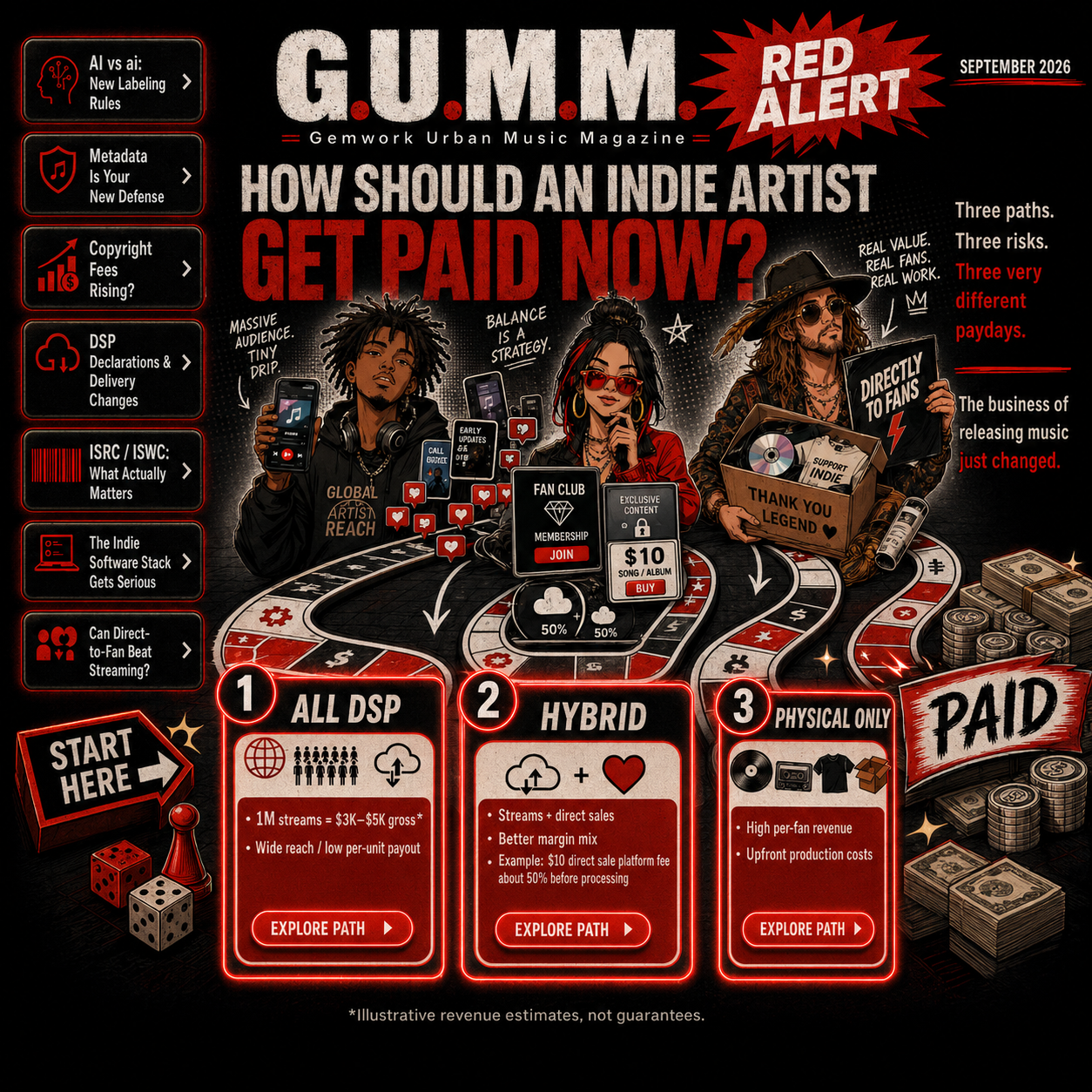
Path 01 made the case for reach. Put the record everywhere, remove friction, read the data, find the fire.
Here’s the problem with stopping there. Reach is not revenue. A listener who loves your record on Spotify is, from a business standpoint, a stranger. You can’t email them. You can’t call them. You can’t tell them the vinyl went up for preorder.
So Path 02 asks a different question:
What if streaming is the top of the funnel, and the bottom of the funnel is something you own?
The hybrid strategy
Keep the music everywhere. Keep the discovery engine running. But build a second surface — a store, a list, a membership, a community — where the people who respond can go deeper and where the economics are completely different.
Not instead of streaming. On top of it.
Why the math changes
Streaming pays out of a pool. Revenue flows in, gets divided by streamshare, and what reaches you depends on your agreements with your label, distributor and publisher. Spotify explains that system here.
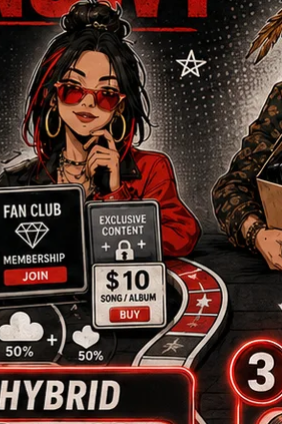
A direct sale works nothing like that. On Bandcamp, the platform takes a 15% revenue share on digital sales and 10% on physical goods, with payment processing adding roughly 4–7% on top. Bandcamp states that “the remainder, usually 80-85%, goes directly to the artist or their label.” Read Bandcamp’s Fair Trade Music Policy.
Those are two fundamentally different transactions. One is a fractional share of a pool. The other is a customer handing you money for a thing.
So why not go direct only?
Because that’s Path 03, and it has its own costs. But also because of this:
Streaming accounted for $9.47 billion of the $11.5 billion in U.S. recorded music revenue in 2025 — roughly 82% of the business — with 106.5 million paid subscription accounts in the U.S. alone. RIAA year-end figures.
That is where listening happens. Walking away from it isn’t strategy, it’s subtraction. The hybrid argument is that you don’t have to choose.
The conversion problem
Here’s the part most independent artists skip. Reach doesn’t convert itself.
A stream doesn’t give you permission to contact anybody. A follow isn’t an email address. Someone can play your song four hundred times and remain completely invisible to you.
You have to ask. And you have to give them a reason.
The reason can be small: the record two weeks early, the instrumentals, a demo nobody else gets, the discount code, the first shot at tickets, the physical copy with something in it. What matters is that the offer is real and that the path to it is short.
What the funnel actually looks like
STREAM → RESPOND → OFFER → OPT-IN → PURCHASE → REPEAT → COMMUNITY
None of those arrows are automatic. Each one is a place people fall out. But every listener who makes it through stops being a statistic in a royalty pool and becomes a customer you can reach on purpose.
And a customer behaves differently than a stream. A stream happens once and pays a fraction. A customer buys again.
Run both sets of numbers
The hybrid artist tracks two scoreboards that measure different things.
Reach metrics: streams, saves, playlist adds, watch time, geography, repeat listeners. These tell you what’s working and where.
Ownership metrics: list size, open rate, conversion rate, repeat purchase rate, revenue per fan. These tell you what your audience is actually worth.
A catalog with big reach and no ownership metrics is a marketing asset somebody else controls. A catalog with strong ownership metrics and no reach is a small business with a discovery problem. Path 02 is the argument for building both at once.
The honest tradeoff
Hybrid is more work than Path 01 and more complicated than Path 03. You’re running a release strategy and a storefront and a list. There are tools to buy, an audience to maintain, and orders to fulfill if you sell anything physical.
It also means your revenue is spread across sources that behave differently — some predictable, some not. That’s a feature when one source dips. It’s a headache when you’re trying to forecast.
Nobody should pretend this is the easy path. It’s the balanced one.
G.U.M.M. Bottom Line
Use the platforms for what they’re genuinely good at: putting your music in front of people who have never heard it. Then give the ones who respond somewhere to go that belongs to you.
Reach plus real revenue. Streaming finds them. Ownership is how you keep them.
 Los Angeles | Redlands | Phoenix | Memphis | NYC
Follow us: @GemworkTV | Contact: info@gemwork.tv
Los Angeles | Redlands | Phoenix | Memphis | NYC
Follow us: @GemworkTV | Contact: info@gemwork.tv