
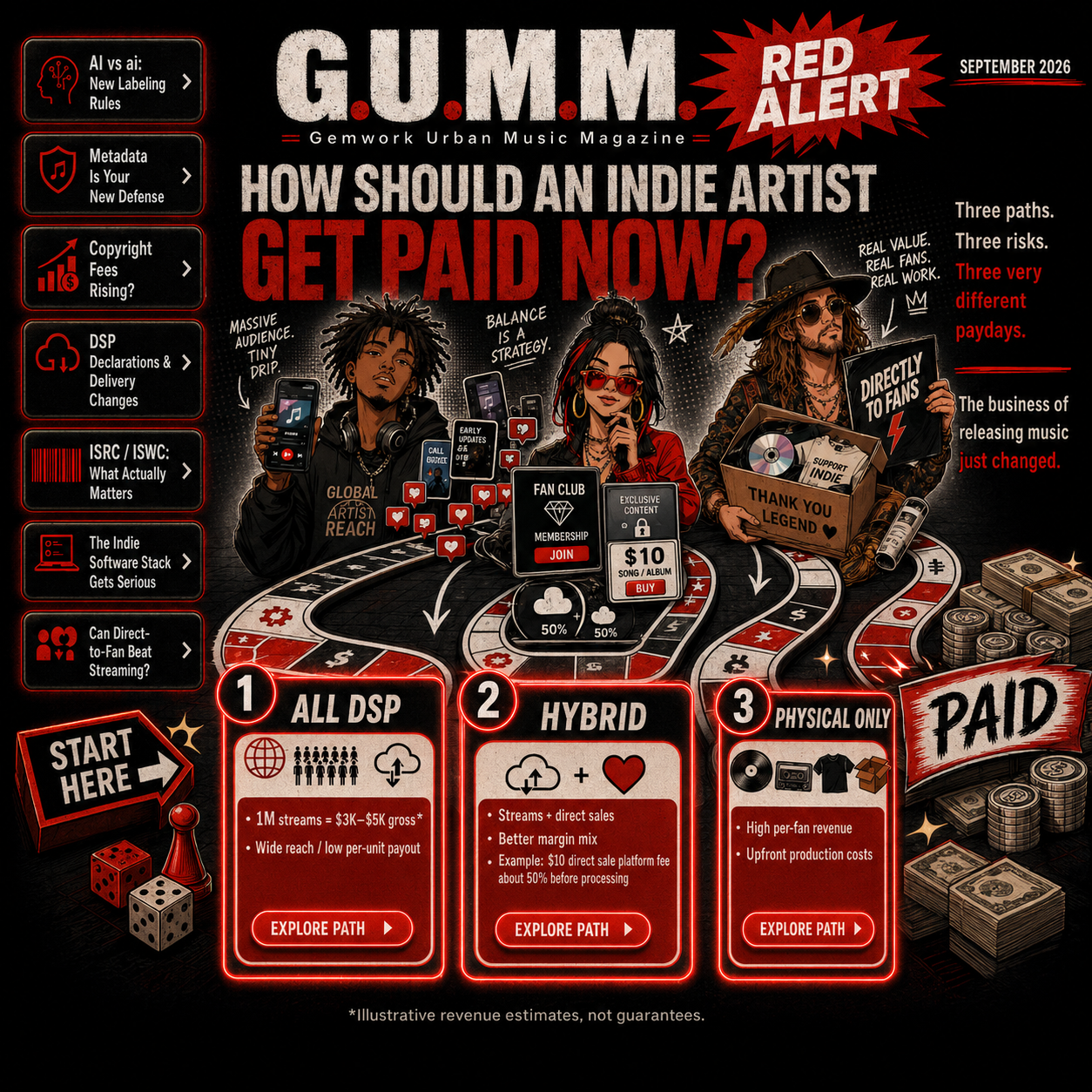
There is a version of the independent music business that has nothing to do with royalty pools, streamshare or platform algorithms.
Somebody hands you money. You hand them a record.
That’s it. That’s the whole transaction. And for a certain kind of artist with a certain kind of audience, it is the most honest business in music.
What if you stopped optimizing for listeners and started building for customers?
The physical case is not nostalgia
It would be easy to write this off as a collector’s hobby. The numbers say otherwise.
U.S. vinyl revenue passed $1 billion in 2025 on 46.8 million units, up from 43.4 million the year before — roughly 9.3% growth, and a nineteenth consecutive year of gains. The average vinyl record price rose about 24% between 2020 and 2025, to $37.22. RIAA year-end figures.
Nineteen years is not a fad. That’s a format with a real, durable market.
But read the rest of the report before you order a pressing. CD revenue fell 7.8% in the same year. Physical is not uniformly healthy — vinyl is carrying it.
Why the per-fan economics are different
The gap isn’t subtle. A streaming play returns a fraction of a pooled payout. A record sold direct returns most of its price.
Bandcamp takes a 10% revenue share on physical goods, with payment processing adding roughly 4–7%, leaving what the company describes as “usually 80-85%” for the artist or label. Bandcamp’s Fair Trade Music Policy. Sell at a show and the platform share disappears entirely.
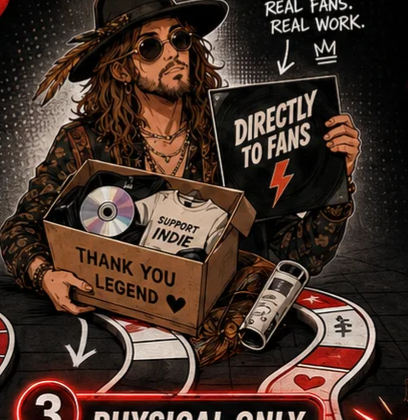
One buyer at $35 is worth more to you than a very large number of streams. That is the entire argument for Path 03, and on its own terms it’s a strong one.
Now the part nobody puts on the flyer
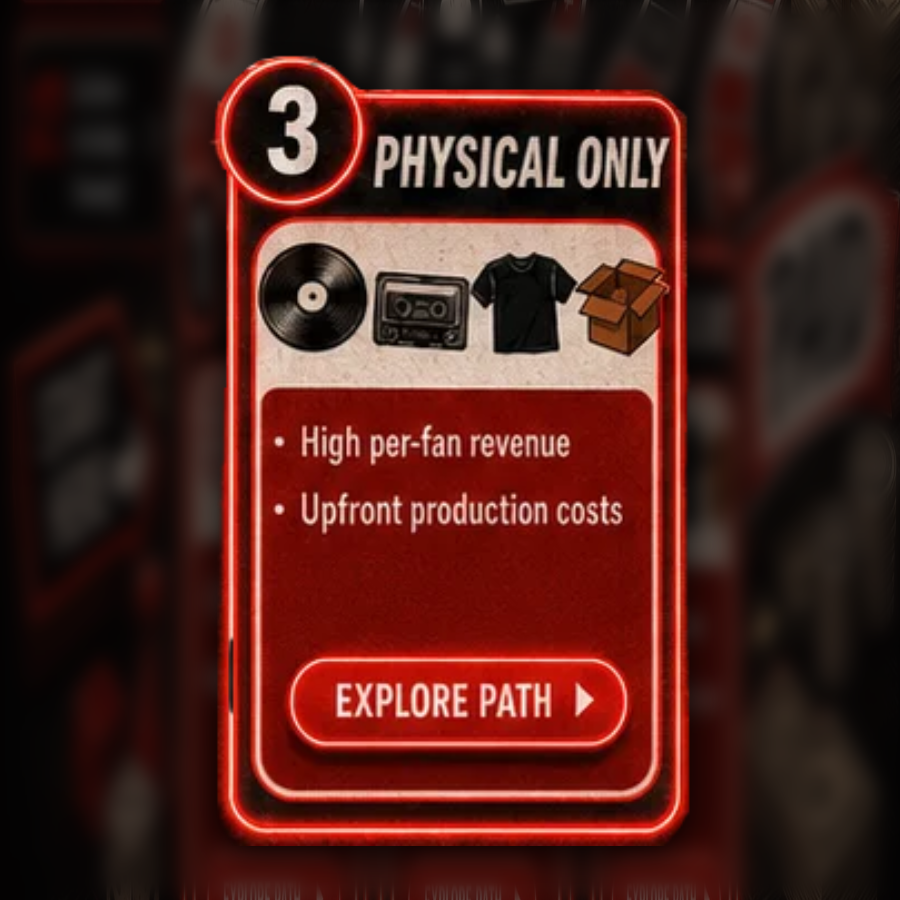
That $35 is not profit. Before a single copy sells, you have already spent money on things a streaming release never required.
Mastering for the format. A vinyl cut is not the same master as your digital release.
Manufacturing. Pressing has a minimum order, a per-unit cost, and a lead time measured in months, not days. You are paying up front for inventory that has not sold.
Packaging and design. Jackets, inserts, sleeves, shrink. Every upgrade is a real per-unit cost.
Storage. Boxes take up space, and space is either your apartment or a bill.
Fulfillment. Mailers, postage, labels, and hours. Shipping a record is a physical task somebody performs one order at a time.
Support. Damaged in transit. Wrong address. Never arrived. Refunds and replacements are part of the business now.
None of that is a reason to avoid physical. It is a reason to price it properly and count it honestly.
The risk is inventory
Here’s the difference that actually matters. A streaming release that underperforms costs you effort. A physical release that underperforms costs you money you already spent.
Unsold stock is capital sitting in a box. That’s the trade: higher potential value per fan, in exchange for real financial exposure before you know whether the demand is there.
Which is why the sequencing tends to matter more than the ambition. Artists who do well with physical usually establish demand first — a list, a community, a track record of people buying things — and press against evidence rather than hope. Preorders exist for exactly this reason.
What physical is actually good at
Beyond the margin, physical does things streaming structurally cannot.
It creates ownership — a shelf, an object, a thing that survives a delisting or a platform shutting down. It creates scarcity, and scarcity supports price. It creates a customer record: a name, an address, a purchase history, an actual relationship you control. And it creates an artifact people bring to shows to get signed, photograph, and show other people.
A stream is a moment. A record is a possession.
Who this path is really for
Physical-first works best when you already have some evidence of demand, when your audience skews toward people who collect, when your release justifies an object — art, liner notes, something worth holding — and when you can absorb the upfront cost without it becoming a crisis if the sell-through is slow.
It works badly as a first move for an artist nobody has heard yet. Reach problems don’t get solved by manufacturing.
G.U.M.M. Bottom Line
Physical is the highest-value-per-fan path in independent music and the only one that asks you to spend money before you make any. Both of those things are true at once.
Real value. Real fans. Real work. Know which part you’re signing up for.

 Los Angeles | Redlands | Phoenix | Memphis | NYC
Follow us: @GemworkTV | Contact: info@gemwork.tv
Los Angeles | Redlands | Phoenix | Memphis | NYC
Follow us: @GemworkTV | Contact: info@gemwork.tv